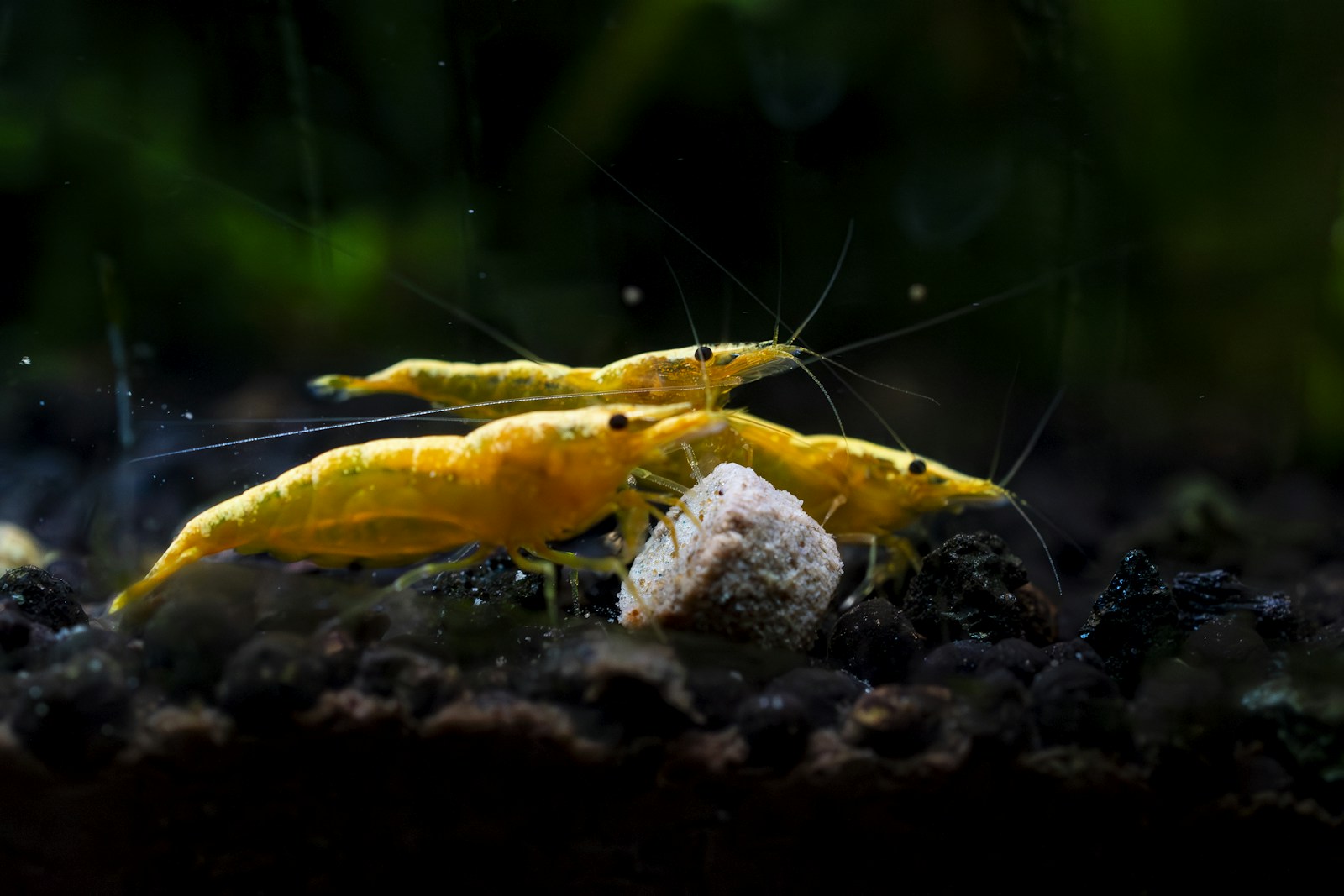
Neocaridina Shrimp Care Guide: Why Shrimp Die and How to Keep Them Alive
Most shrimp keepers lose their first colony in the first month. Not because shrimp are fragile, they are not, but because almost every piece of common advice about them is missing the one variable that actually kills them. This guide is written specifically to keep your shrimp alive past the first six weeks, when most colonies fail.
Quick Start
- Tank: 5 gallons minimum, 10 gallons strongly preferred. A bigger tank is a more stable tank.
- Mandatory cycling for 4 to 6 weeks before adding shrimp. Not negotiable.
- Water: pH 6.8 to 7.5, temperature 65 to 78 degrees F, GH 6 to 8, KH 2 to 4, TDS 150 to 250.
- Get a TDS pen. Without one you are guessing.
- Drip acclimate slowly, 90 to 120 minutes minimum. Faster will kill them.
- No fish in a shrimp tank if you actually want a colony.
- Feed lightly, every other day. Uneaten food is the second leading cause of crashes.
Water Parameters
Neocaridina are tougher than caridina shrimp (crystal reds, taiwan bees) and tolerate a wider range, but the range is not infinite. The numbers below are not a wish list, they are what stable colonies actually live in.
| Parameter | Target Range | Why It Matters |
|---|---|---|
| pH | 6.8 to 7.5 | Stable trumps any exact value. |
| Temperature | 65 to 78 degrees F | Cooler extends lifespan. 72 is the sweet spot. |
| General Hardness (GH) | 6 to 8 dGH | Needed for shell building and molting. |
| Carbonate Hardness (KH) | 2 to 4 dKH | Buffer to prevent pH crashes. |
| TDS | 150 to 250 ppm | The number that quietly kills colonies. See below. |
| Ammonia / Nitrite | 0 ppm | Lethal to shrimp at any detectable level. |
| Nitrate | Under 20 ppm | More sensitive than fish. |
| Tank Size | 5 gallons minimum | 10 gallons is much more forgiving. |
The Number One Killer: TDS Swings
TDS, total dissolved solids, is the sum of all minerals, salts, and other ions in your water. It is measured in parts per million with a cheap pen probe, twenty dollars, and it is the single most important number in shrimp keeping. More important than pH. More important than temperature.
Here is the situation. A shrimp's internal fluid chemistry needs to be in osmotic balance with the surrounding water. When TDS changes by more than 30 or 40 ppm in a short window, the shrimp cannot adjust fast enough and water moves into or out of its body. They molt prematurely, they fail to complete the molt, they get stuck halfway out of the old shell, and they die. This is what people are seeing when they describe "shrimp dying for no reason" or "shrimp dropping a few days after a water change."
What causes TDS swings:
- Large water changes with mineralized water that does not match. Your tank reads 200 ppm, your top-up water reads 320 ppm, you change 50 percent, the shrimp get hit with a 60 ppm jump in minutes.
- Topping off evaporation with mineralized tap water. As water evaporates, minerals stay behind. Topping off with tap concentrates them further. Always top off with reverse osmosis or distilled water.
- Brand new tanks that have not stabilized. Substrates, rocks, and driftwood leach for weeks. Cycle first.
- Switching mineral products or remineralizing differently between water changes.
Acclimation Mistakes
The second biggest source of new-shrimp death is rushed acclimation. Shrimp from any breeder, including ours, have been in shipping water for 24 to 48 hours. That water has different pH, different TDS, and different temperature than your tank. Dumping them in is the same as throwing a person from a sauna into an ice bath. They might survive but they will be wrecked.
Drip acclimate every batch over at least 90 minutes, and 2 hours is better. Our full drip acclimation guide has a step by step walkthrough. The short version: float the bag for 15 minutes to match temperature, then drip your tank water in at 2 to 4 drops per second using airline tubing and a control valve until the receiving container has at least tripled in volume. Net the shrimp into the tank, do not pour the bag water in.
Cycling Is Not Optional
A new aquarium is a sterile bucket of water. Add a living animal and its waste produces ammonia, which is acutely toxic. Beneficial bacteria eventually colonize the filter and substrate and convert ammonia to nitrite (also toxic) and then to nitrate (much less toxic). This process takes four to six weeks and it must be complete before shrimp go in.
To cycle a shrimp tank: set it up exactly as you intend to run it, add a source of ammonia (pure ammonia drops dosed to 2 ppm, or a small piece of fish food), and test daily until ammonia and nitrite both read zero within 24 hours of dosing. Then do a 50 percent water change, check TDS and parameters one more time, and acclimate your shrimp.
Shrimp keepers who skip cycling lose their entire colony in the first two weeks and then blame the breeder. We are not subtle about this because we see it every shipping season.
Food and Calcium
Shrimp eat constantly but they eat very little at a time. In a properly biofilmed tank with a few weeks of maturity, they get most of their calories from grazing the substrate, plants, and driftwood. Supplemental food is a small bonus, not a main course.
What we feed
- A high quality shrimp pellet (Bacter AE, Shrimp King, Hikari) the size of a pinhead, every other day. Remove uneaten food after two hours.
- Blanched vegetables once or twice a week: spinach, zucchini, mulberry leaf. They will swarm it.
- Cholla wood or oak leaves in the tank permanently as grazing biofilm.
- Calcium source: a small piece of cuttlebone or mineral stone in the tank. Calcium is required for successful molting and shell formation. Calcium deficiency causes the "white ring of death" (more on this below).
Overfeeding is the most common mistake after skipping cycling. A pellet the size of your fingernail is enough for 50 shrimp. If the pellet is still there in the morning, you fed too much and you should fast for two days.
Tank Mates
If you want a breeding shrimp colony, keep them alone. This sounds boring and it is the correct answer. Almost every fish will eat shrimplets and many will eat adults. A colony cannot replenish itself if every newborn gets snapped up.
Fish that are sometimes okay in a heavily planted, mature tank: otocinclus, pygmy corydoras, small rasboras (chili, ember). Even these will eat shrimplets. Fish that will destroy a colony: bettas, gouramis, angelfish, any cichlid, most tetras, guppies (yes, even guppies, in a sparse tank), goldfish, anything with a mouth.
Compatible non-fish tankmates: nerite snails, mystery snails, ramshorn snails. Snails and shrimp coexist perfectly and the snails help with biofilm management.
Color Genetics and Keeping Strains Separate
All neocaridina are the same species, Neocaridina davidi. Red cherry, blue dream, yellow, green jade, orange sakura, black rose, all of them. They will all interbreed freely, and when they do, the offspring revert to the wild type: a translucent brown gray. Within two or three generations a mixed tank produces nothing but wild-colored shrimp.
If you want a colored colony, keep one color per tank. Do not mix. The genetics are dominant for wild type and the bright colors are the result of decades of selective breeding for recessive or polygenic traits. Mixing throws all that work away in months.
Browse our pure strain lines in the shrimp shop. Our blue dream neocaridina and red cherry shrimp are sold as locked, sorted grade so you start with a strong color base.
Breeding
If your shrimp are alive and your water is stable, they will breed. This is the easiest part of shrimp keeping and the part that takes care of itself. A mature female carries 20 to 30 eggs under her tail for 30 days, then releases fully formed shrimplets that look like tiny adults.
To get more berried (egg-carrying) females, keep parameters stable, feed slightly more, and add cover. Java moss, cholla wood, and dense planting give shrimplets places to hide. A bare tank with no cover produces fewer surviving young because the adults will sometimes eat newborns and the shrimplets cannot escape water currents.
Expect to see your first berried females two to four weeks after they settle into a stable tank. If three months pass without any berried females, something is wrong with the parameters, usually TDS too high or too low, or temperature outside the productive range.
Symptoms Decoded
The white ring of death
Symptoms: a clear or white band visible across the body just behind the head, in an otherwise normal looking shrimp. Cause: failed molt. The shrimp has separated the old shell from the new but cannot complete the shed. This is usually a calcium deficiency or a sudden water change that triggered a molt the shrimp was not ready for. Fix: too late for the affected shrimp, it will die within 24 hours. For the colony, add a cuttlebone or mineral stone, check that GH is at least 6, and reduce the size of your water changes.
No berried females
Symptoms: a colony of adult shrimp, all of them apparently healthy, but no eggs and no shrimplets for months. Cause: stress from unstable parameters, TDS too low (under 130) or too high (over 300), temperature too cold, or all males. Fix: verify both sexes are present (females are larger with a curved "saddle" of eggs visible behind the head), stabilize parameters, raise temperature to 74 to 76 degrees, feed slightly more.
Mass die-off after a water change
Symptoms: healthy colony, you do a water change, within 48 hours half of them are dead on the substrate. Cause: TDS shock, almost always. New water did not match tank water in mineral content. Fix: from here forward, mix your replacement water in advance, let it sit overnight with an air stone, test TDS, and only use it if it is within 20 ppm of the tank. Do smaller, more frequent changes.
Shrimp turning white or pale before dying
Symptoms: previously bright red or blue shrimp lose color over days, become sluggish, then die. Cause: bacterial infection, often Vorticella or a Vibrio strain, triggered by poor water quality or chronic stress. Fix: large gradual water change with matched TDS, increase aeration, salt is not safe for shrimp so do not use it. Some keepers use a half dose of Seachem Paraguard for short courses but most cases are too far gone by the time color loss is visible.
Shrimplets disappearing
Symptoms: berried females release young, you see them for a week, then they vanish. Cause: almost always a fish tankmate that you thought was shrimp safe. Sometimes hydra (small jellyfish like organisms attached to glass). Fix: remove fish, treat hydra with fenbendazole if present, add more dense cover.